
What's the first thing that comes to mind when someone says "Mauritius holiday?" A sun lounger? A book you'll never finish? A few rum punches? Yeah, that's one holiday but there is an alternative one...
One where you're out the door early. Where it's just you and your wheels spinning along the coastline, past a turquoise blue lagoon. Coming back with that glow on your face that says "I've just had a hard days riding and am ready for a sun lounger and some rum punch".
That's the beauty of cycling in Mauritius. It's two holidays for the price of one. You can spend mornings or late afternoons exploring the flat, beginner-friendly coastline or climbing the volcanic interior. Then you can spend the rest of your day sampling water sports, lazing around, living the Island life.
Here's where to ride, when to go, how to get started if you're new to it, and how to build a week around it.
Is Mauritius good for cycling?
The short answer? Yes. And a lot more than you'd expect from somewhere more known for honeymoons than freehubs.
It helps to picture the island as two riding worlds stacked on top of each other. The coast is flatter, scenic and quiet. The kind of riding where you can hold a conversation, look at the view and still average a respectable speed. The interior is a different animal entirely. Volcanic, green and steep, with gradients sitting around 10% on the way up from the coast and kicking to roughly 15% on the push into Black River Gorges National Park.
Then there's its size. Mauritius is roughly the size of Greater London, and you can drive across it in well under two hours. No route is ever really that far from your base. That means you can spin the flat north coast one morning, go hunting for climbs in the south-west the next, with no need to pack a bag in between.
The only downside is the roads. The coastal roads are generally quiet and bike-friendly, with decent surfaces and drivers who are used to seeing riders. The main roads through the interior and around the capital, Port Louis, are a different story. They get congested, particularly at either end of the working day, so it's worth planning your ride around rush hour. And buses don't carry bikes, so build your rides as loops out and back from where you're staying rather than counting on public transport to get you back.
The upside is the bit the photos can't capture. The smell of sugarcane fields running alongside the roads edge. How the lagoon shifts colour as you cylce around it. And just how breathtaking Le Morne is as the sun rises or settles in behind it.
When is the best time to cycle in Mauritius?
Mauritius runs on two seasons rather than four, and for cycling the choice is simple.
Winter (May through October): Cooler, drier and far less humid, these are the conditions that let you rattle off the miles.
Summer (November to April): Warmer, wetter and considerably stickier. Still rideable, but every kilometre will feel harder.
Heat is the constant whatever month you land in, which means the cool of the morning is your best friend, and is the reason why serious riders are back at the breakfast buffet before others have even gotten up.
Altitude can offer some relief from the heat, if early mornings aren't for you. Conditions in the higher interior are often cooler than on the coast, but the difference varies with altitude, weather and time of day.
Quick note. the official cyclone season in the south-west Indian Ocean runs from November to May, although cyclone activity affecting Mauritius is generally more likely during the warmer summer months (January – March). Which means heavier rain and the occasional storm could impact your ride.
Fancy doing a bit of windsurfing after cycling? Check out our guide on everything you need to know about windsurfing in Mauritius.
The best cycling routes in Mauritius
There's something in Mauritius for every kind of cyclist. Below you'll find flat coastal cruises you could tackle on your first proper ride, a climb that'll leave your quads trembling and have you swearing at gradient signs, and a few that sit comfortably in between.
Route distances, ascent figures and estimated times are approximate and can change if the mapped route is updated. Open each route link before setting out, check the surface and elevation profile, and download the route for offline use. Choose a bike and route that suit your fitness, experience and the current conditions.
Going to Trou — the flat one
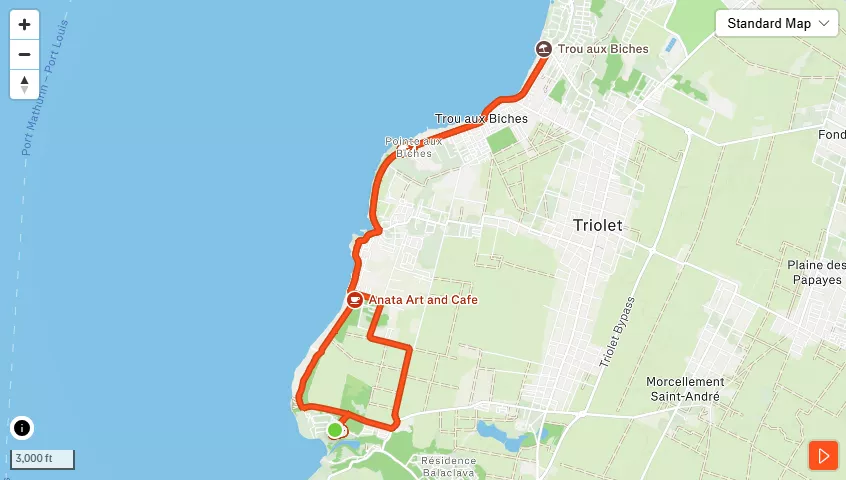
Distance: 16.9km | Duration: ~1 hour | Ascent: 24m | Difficulty: Easy, flat
This is the one to do first. Twenty-four metres of climbing across the whole 17km, and the highest point you'll reach is 23m above sea level - so if you've been putting off getting back on a bike, this is a great place to start.
You head out on the backroads of Pointe aux Piments rather than straight onto the coast road, which keeps the traffic down. Before long you're in Triolet, and from there the route swings back towards the water.
You rejoin the coast at Trou aux Biches, roughly halfway round at the 9km mark. It's a lovely beach to stop at and has the added bonus of a handful of local food stalls nearby, if your carb mix and gels don't cut it.
From there it's a cruise back down the scenic coast road with the lagoon alongside you. At around 14km you'll pass Anata Art and Cafe, which leaves you exactly enough time for a coffee before the last three kilometres home. Highly recommended. And you can always say you've earned it, anyway.
Route: https://www.strava.com/routes/3517499451281259280
Fancy riding the Going to Trou, then book a stay at the Neilson x The Ravenala Attitude.
The climb to Chamarel & Black River Gorges
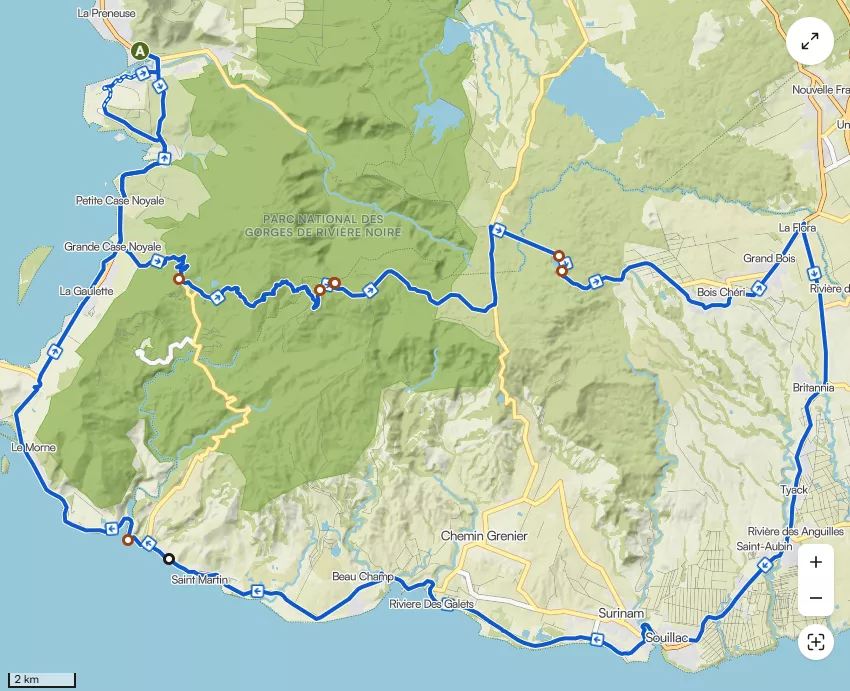
Distance: 95km – 100km Duration: Half-day | Elevation: 1,190m | Difficulty: Hard
If people came to Mauritius for cycling, this would be the ride that they'd want to tick off.
From Grande Case Noyale the gradient settles around 10% and stays there, then kicks to roughly 15% on the push into Black River Gorges National Park. Your quads will shudder with every turn of the pedal, and your lowest gear won't feel low enough.
If that all feels a little too much, then you can take a gentler road up from Baie du Cap rather than the brutal Case Noyale side. It's just as scenic, but gentler on the legs, and won't write you off for the rest of the day.
Even though all that suffering doesn't sound like fun, what you get more than makes up for it with Panoramic west-coast views, the Chamarel waterfall, national-park forests and ravines, all backdrops to this ride.
Route map: https://www.komoot.com/smarttour/1254603
Le Morne & the south-west coast — Baie du Cap to La Prairie
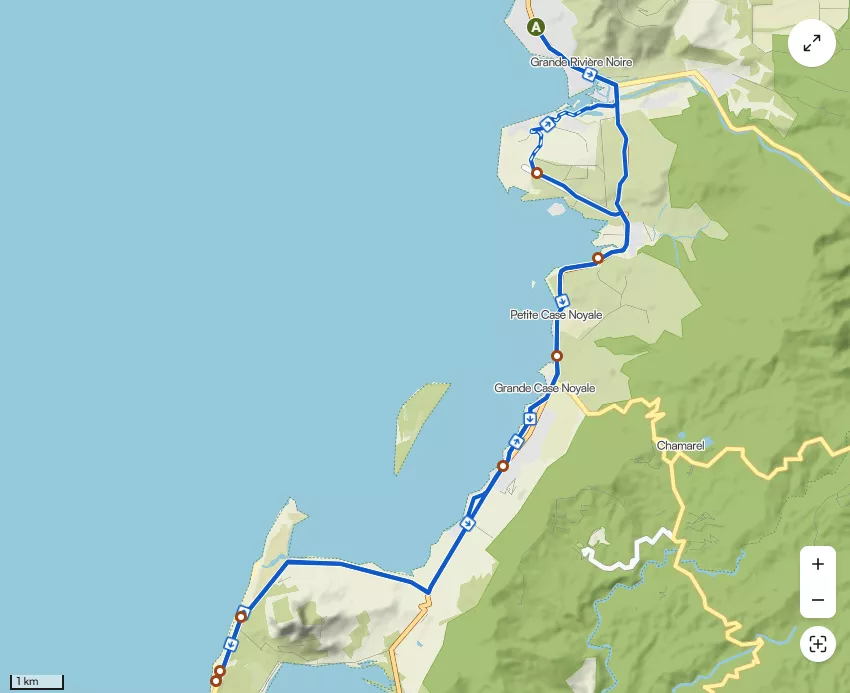
Distance: ~39.5km | Duration: 2–3 hours | Difficulty: Moderate
This is the route for riders who want the heart rate to spike a but don't want to come back to the hotel completely knackered.
The road winds around the Le Morne Brabant peninsula, a UNESCO World Heritage site and the most dramatic stretch of coastline on the island with views of this sheer basalt monolith dropping straight into the lagoon. You've got the sea breeze with you the whole way and, if you time it right, a sunset finish at La Prairie.
The Le Morne Brabant loop from La Preneuse is the local favourite, coming in at around 39.5km. It's noticeably quieter down here than up north, with the kind of coastal views that make the moderate amount of suffering feel like a fair trade.
Route map: https://www.komoot.com/smarttour/17028592
Gunners 8 — the one with a bit of a kick
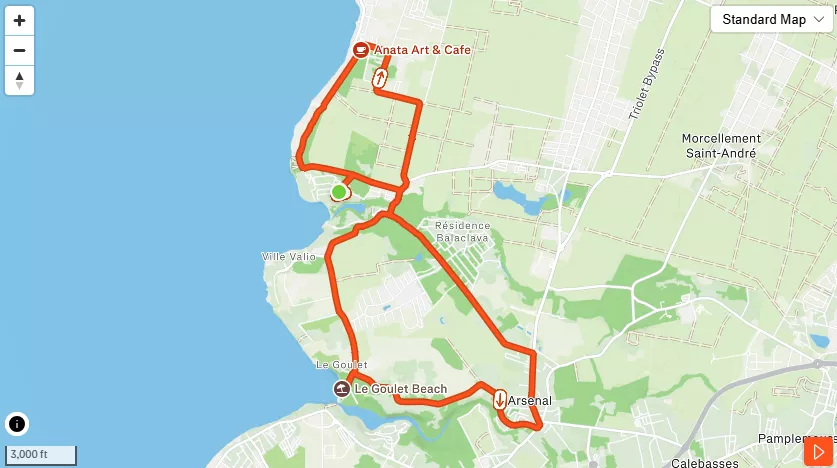
Distance: 16.9km | Duration: ~1 hour 10 | Ascent: 78m | Difficulty: Easy–moderate
Hilly enough to feel it in your legs, but not so hilly that it's an insurmountable task for inexperienced riders.
The early highlight comes quickly. About four kilometres in you reach Le Goulet, a tropical bay with a sandy bottom that makes it a proper spot for a swim rather than a paddle. Plenty of people build the ride around a dip here and worry about the rest afterwards.
After that the route turns inland through the town of Arsenal, and this is where the climbs start to kick in. Don't worry though, they're more of a steady drag than something that'll have you out of the saddle.
You drop back down to the coast at Pointe aux Piments beach, where there are a couple of good coffee options. Fuel up there and before a short, flat run back into the hotel.
Route: https://www.strava.com/routes/3517499443518931950
Fancy riding the Gunners 8, then book a stay at the Neilson x The Ravenala Attitude.
The north coast cruise — Trou aux Biches to Cap Malheureux
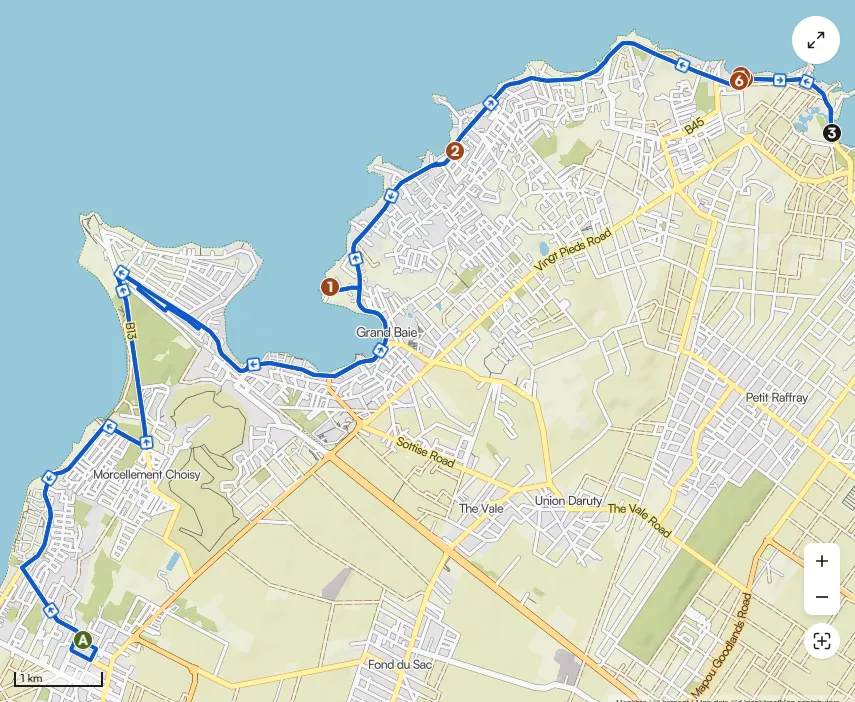
Distance: ~20–37km | Duration: 1–2 hours | Difficulty: Easy
If you're new to cycling, or you simply want a first day in the saddle that doesn't hurt, start here. The road stays flat and hugs the coast the whole way, with white sand on one side and that improbably blue lagoon on the other.
You'll roll out past Trou aux Biches beach, carry on through Pereybere, and finish at Cap Malheureux and its red-roofed church.
Experienced riders shouldn't write it off either. Treat it as a warm welcome. An easy spin to loosen the legs before you go looking for something more challenging.
It's also the riding closest to Balaclava and the north-west coast, which makes it the doorstep ride if you're staying with us at Neilson x The Ravenala Attitude.
Route map: https://www.komoot.com/smarttour/17028462
The east coast — Belle Mare & Bras d'Eau
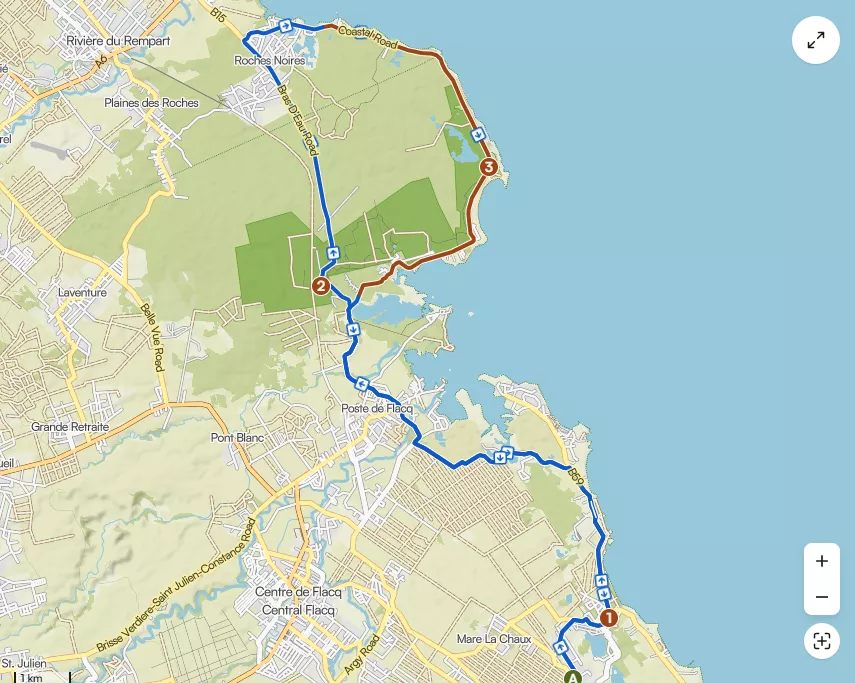
Distance: 38km | Duration: 2–3 hours | Elevation: 130m | Difficulty: Easy–moderate
Head east and the island slows down. This is flat, open riding on quiet roads with good surfaces, which makes it ideal if you're still finding your confidence or you're bout with someone who is.
You'll ride past wetlands and long beaches around Belle Mare, where the traffic thins right out. The highlight is Bras d'Eau National Park: flat, shaded paths winding through ancient ebony groves and Araucaria trees. After an hour in open sun, riding into that shade feels like stepping into an igloo.
It feels more local over this side too. Fewer resorts, more villages, and a slower pace to the whole thing than you'll find in the busier north.
Route map: https://www.komoot.com/smarttour/20101553
Tips for cycling in Mauritius
Hire, don't fly it: A long-haul flight means a long time in the hold, and that's a real risk if your bike costs more than your first car. Hiring on the island is simpler and cheaper, and if you're with us at Neilson x The Ravenala Attitude, e-bikes are included in the holiday anyway.
Beat the heat: Get out before the sun's properly up, and carry more water than you think you'll need. Then carry a bit more on top of that.
Dress for the sun: Light, breathable, brightly coloured kit. Skip the dark jersey, it'll soak up heat. Sun cream and sunglasses aren't optional.
Plan loops: Buses don't carry bikes and the old railway is long gone, so build your rides out and back from your base.
Know where the traffic is: Coastal roads stay quiet. The interior and Port Louis get busy, so dodge rush hour.
Cycling with Neilson at The Ravenala Attitude
If you'd rather not organise any of the above yourself, this is where we come in.
Neilson x The Ravenala Attitude sits on the sheltered north-west coast at Turtle Bay, Balaclava. Quiet coast roads start at the end of the drive, and Grand Baie, Pamplemousses and Port Louis are all close by. It's around 60 minutes from the airport, with direct flights from London Gatwick.
Let's be straight about the riding, though. What we run here is relaxed, easy-going e-bike cycling on a fleet of Trek Marlin 8+ (2026) e-bikes in a full range of sizes. You can join a guided ride with our local team, or buddy up with someone and head out along the coast at your own pace.
This is coastal cruising, not segment hunting on Strava. If you're training for something specific, you'll want to plan your own bigger days out. But if you want to spend a couple of hours each morning riding somewhere lovely with the bike already sorted and nothing to book, it's hard to beat.
And because everything's included, the cycling sits alongside paddle boarding, tennis, padel, pickleball and fitness classes. Ride in the morning, paddle board in the afternoon, and still make it back for that cocktail.
Take a look at Neilson x The Ravenala Attitude to see what a week there looks like.
Fancy a ride?
Mauritius has something for every kind of cyclist. An interior of rolling hills and seriously tasty climbs. Flat, quiet coastal roads and lagoon views if you want a gentle morning and a good coffee at the end of it. And because the whole lot is packed into an island the size of Greater London, you can have both in the same week without ever moving hotel.
Add in reliable winter sunshine, warm water to swim in afterwards and a cocktail with your name on it, and it's a difficult trip to argue against.
Want more content on Mauritius? Check out our posts on why you should Paddle board in Mauritius, Best snorkelling spots in Mauritius and the best Mauritian dishes to try.


